
Archive for the ‘Writing’ Category.

Instructor Froon Gets a Separate Page

I’m teaching yet more UCLA Extension Writers’ Program classes in the coming months, but rather than clutter this blog with yet more writing-course posts, I’m consolidating all information about what I’m teaching on a page entitled, appropriately enough, Writing Classes, also available via link from the navbar at the top.

UCLA Extension Writers Faire

Young Hall Courtyard at UCLA

A previous Writers Faire. Note that you don’t need to come in costume to enjoy yourself.

Sunday, August 26, 2012, 11am to 3pm, Young Hall Courtyard, UCLA Campus, Westwood

It’s a free day of 24 mini-classes and panel discussions on all kinds of creative writing: TV, features, novels, short stories, and more.

And an exhibit mall (opens at 10am) with terrific organizations such as PEN USA, the Organization of Black Screenwriters, the Writers Guild Foundation, and many more.

And an opportunity to register for most fall courses (including the one I’m teaching) at a 10% discount!

And a chance to see the panel I’m doing with three other TV writers / UCLA Extension instructors (Erica Byrne, Richard Hatem, and Charles Rosin) from 11:00 to 11:40am: Writing the One-Hour Drama Spec and Pilot. 

The official description: “Get tips on how to choose a show to spec, how to capture its distinct voice and tone, and on the flip side, how to create a one-hour pilot that can be sustained for 100 episodes and beyond.” Or, we might just sit there and swap television horror stories for 40 minutes. Either way, it should be instructional and/or entertaining!

Visit the UCLA Extension Writers’ Program site for more information.

Hope to see you there!

The Elements of Television

Element Froonium

Element Froonium. Click for details.

I was channel-surfing with my obnoxiously precocious six-year-old niece Gabby (her full name is Gabrielle Callisto Aphrodite Zimbelman; she was conceived at a Xena convention) when we stumbled upon a rerun of Blaster Patrol. “My favorite show! Did you write this one, Uncle Ricky?”

“No, Gabby, I never worked on Blaster Patrol, more’s the pity.”

On the tube, Sam and Janet, the series leads, were being chased by evil alien Greebs and were simultaneously firing blasters and exchanging witty yet affectionate banter. “Sigh,” Gabby sighed, “they’re soooooooo in love. Are they married?”

“Sam and Janet? No, they never got married, even though, much to everyone’s amazement, the show ran for six seasons…”

“Not the characters, silly. The actors.”

“Oh. Yeah, she’s married. Third or fourth time; I can’t keep track. Him, he’ll never get married unless the father of the bride owns a shotgun.”

Gabby couldn’t fathom it. “But… they love each other… don’t they?”

“You kidding? When the camera’s not rolling, they can’t stand one another.” I omitted mentioning that she thought he was a lecherous drunk who couldn’t remember his lines, and he thought she was a ruthless, upstaging diva who despised television in general and sci-fi in particular.

Gabby’s lower lip quivered. She indicated Sam and Janet, who were celebrating their escape from the Greebs with much kissing and fondling. “Look at them. You’re wrong.”

“Honey, it’s all make-believe. They’re actors. They’re faking it.”

Her Bambi eyes clouded with doubt—but as Sam and Janet exchanged perfect loving gazes, her conviction returned. “Nuh-uh. Nobody could fake that.”

And there, I reflected, was the biggest reason why that otherwise unmemorable show had run for six years. Separately, the actors playing Sam and Janet had been no more than competent—but together, they had the most elusive and valuable commodity in show business: chemistry.

Continue reading ‘The Elements of Television’ »

Tales from the Writers’ Room

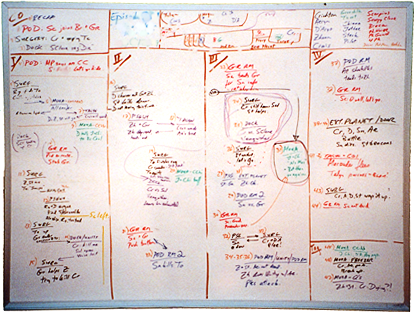
An actual whiteboard from an actual TV series.

Actual whiteboard from FARSCAPE "Season of Death"

Picture, if you will, perky young Mary Sue, an aspiring TV writer who’s celebrating her first sale. She pitched a dozen ideas to veteran genre-TV producer Sam Showrunner for his new series Space Slayers, in which a ragtag team of teenage misfits travels the galaxy and battles alien mutants. But Mary Sue’s enthusiasm will soon be tested; she has no idea what terrors await in… The Writers’ Room.

Mary Sue’s successful pitch:“Griff and Angela [the series leads] must mind-link with K’Vax [their sentient, female, wisecracking spaceship] after a radioactive nebula erases K’Vax’s memories.”

There was more to her pitch – such as the mind-link forcing the aloof Griff and Angela to confront their true feelings about one another – but Mary Sue never got that far; Sam had interrupted. “Good hook, but amnesia’s soft. Needs more jeopardy. Hey! What if the nebula turns K’Vax evil? And she tries to kill everybody on board! So it’s dangerous for Griff and Angela to go into her mind; they might never come out. Terrific pitch! Sold!”

Mary Sue was ecstatic. “Great! I’ll write up an outline –”

“We don’t do outlines. We – me and the writing staff – break all our stories in the room. Once we get the structure down, you go off and write the script. Come in Tuesday at nine. Bring in a beat sheet. Not an outline, just the big moves. Some rough act breaks. Keep it simple. One page, tops, just to get things started.”

And so it begins…

Continue reading ‘Tales from the Writers’ Room’ »

Blinded by Science (Fiction)

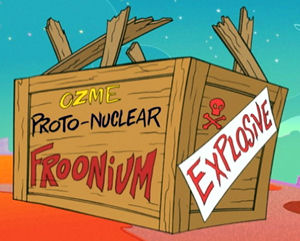
Case in point. Froonium isn't proto-nuclear.

Case in point. Froonium isn't proto-nuclear.

Science quiz! Which of these is the least scientifically plausible?
  1. An alien species can project heat rays that can fry humans dead… or serve as a powerful truth serum.
  2. A society has developed a liquid “litmus test”: just dab a drop on your lips and kiss someone. If the kiss tastes sweet, your DNA is compatible for having healthy children.
  3. They’ve also got technology that can turn people into metallic statues… and back again. While you’re a statue, you remain fully conscious, you can see and hear just fine, and you don’t age. If your statue’s head is lasered off, it can be reattached with no ill effects.
  4. A human wearing no protective gear jumps out of a spaceship in orbit, spends a minute in vacuum… and survives.

If you answered #4, you’re not alone… but you’re incorrect. All the above are from Farscape‘s “Look at the Princess” trilogy of episodes, to which a lot of viewers reacted “No way! That just couldn’t happen!” And they weren’t talking about #1 or #2 or #3… few even blinked at those. No, it was #4 that got people flustered.

(Well, okay, some of our fans were far more perturbed that our hero had sex with someone other than our heroine… but that’s a different discussion entirely.)

Everybody “knows” you can’t survive in outer space. But as it happens, #4 was one time – possibly the only time – that Farscape got its science more or less right. Humans exposed to vacuum do not promptly blow up like balloons and explode. Their eyeballs don’t pop, their blood doesn’t boil, nor do they instantly freeze solid. In fact, according to NASA, if you don’t try to hold your breath, half a minute or so of vacuum exposure won’t damage you permanently.

So why could viewers accept “truth rays” and living statues and DNA kiss tests, but not a suitless space walk? Because what’s true is rarely what’s believable.
Continue reading ‘Blinded by Science (Fiction)’ »

Genre TV: Why Bother?

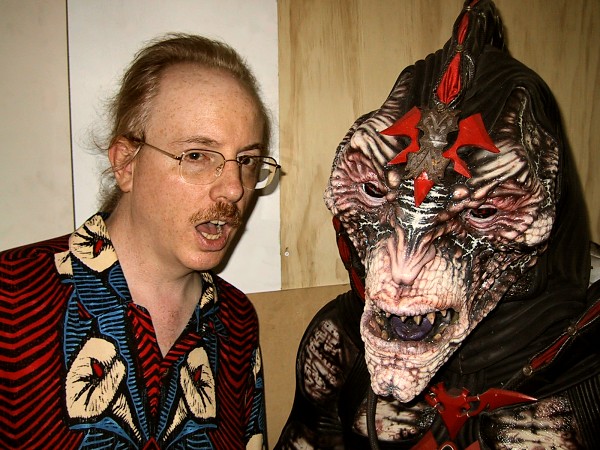
Ricky + Wolesh

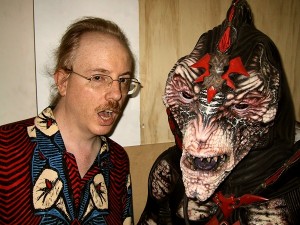
Singing the praises of genre TV: The author (left) harmonizes with a Scarran named Wolesh (right).

“Genre” television — science fiction, fantasy, and other so-called “non-mainstream” shows — is expensive, tough to produce, and tougher to produce well.

The occasional breakout hit notwithstanding, it’s also a niche product, constantly struggling to corral enough viewers to survive. And it’s next to invisible at the Emmys or BAFTAs.

In short, it gets no respect.

So why do we make it?

Two simple reasons: money and groupies.

All right, I confess: there’s a third reason…

Continue reading ‘Genre TV: Why Bother?’ »